
Train for a career in healthcare
Explore Avicenna’s allied health programs, from patient care and clinical support to medical billing and coding.

What to expect as a student
The program guide suggests planning for 10–15 hours a week for online coursework, live instruction, assignments, and practice. Your schedule depends on your program and any required labs or clinical sessions. Most courses include at least 3 hours face to face with a healthcare professional and then 2 hours working in a live clinic applying what you are learning!

A typical week
- Work through online modules, lectures, assigned readings, and quizzes.
- Join required live sessions to ask questions and work with instructors and classmates.
- Complete assignments, case studies, and discussions, and attend scheduled labs or clinical practice.
- Check grades and feedback, review the week’s material, and prepare for upcoming assessments.
- Prepare – Practice – Perform!
Support from enrollment to graduation
- Academic support: Tutoring, instructor guidance, study strategies, and test preparation.
- Technical support: Help with Canvas, Zoom, Quizlet, email, and other learning tools.
- Advising and referrals: Help tracking program requirements and progress, plus referrals when personal challenges arise.
- Career support: Résumé help, interview preparation, job search strategies, and guidance on externship opportunities.
Training programs
Find the right program for you
Explore certificate programs and specialty training. Offerings vary by campus.
Medical Assisting
Prepare for outpatient clinical work through classroom instruction, lab practice, and simulation.
What you’ll learn in Medical Assisting
Patient histories, vital signs, specimen collection, basic diagnostic testing, patient education, and referral management.
You will work online, 3 hours live with the instructor and 2 hours weekly in the clinic!
Dental Assisting
Build chairside skills for general and specialty dental practices.
What you’ll learn in Dental Assisting
At Avicenna Allied Health Institute, you’ll learn how to assist dentists during routine and specialty procedures. You’ll study dental anatomy and infection control, then practice preparing treatment rooms, sterilizing instruments, and passing instruments and managing suction while the dentist works.
You’ll also learn how to take dental X-rays and prepare materials used for fillings and other restorations. A 100-hour supervised clinical externship gives you the opportunity to apply these skills in a dental practice.
You will work online, 3 hours live with the instructor and 2 hours weekly in the clinic!
Medical Billing and Coding Specialist
Work through coding and billing cases from documentation to reimbursement.
What you’ll learn in Medical Billing and Coding Specialist
At Avicenna Allied Health Institute, you’ll learn to read medical records and assign codes for diagnoses, procedures, and supplies using ICD-10-CM, CPT, and HCPCS Level II. You’ll practice applying coding guidelines to sample patient cases while protecting patient privacy.
You’ll also learn how to prepare and process insurance claims, identify why claims are rejected or denied, and follow a claim from submission through reimbursement. A 40-hour supervised capstone gives you the opportunity to apply your coding and billing skills in a professional setting.
Patient Care Technician
Develop skills for direct patient support through classroom instruction, labs, and simulation.
What you’ll learn in Patient Care Technician
Vital signs, activities of daily living, safe mobility and positioning, documentation, venipuncture, and 12-lead EKG basics.
Behavioral Health Technician
Prepare to support patients in behavioral health and recovery settings.
What you’ll learn in Behavioral Health Technician
Trauma-informed communication, patient rights, observation, crisis recognition, de-escalation, safe patient handling, and documentation.
Pharmacy Technician
Learn pharmacy workflows used in retail, hospital, and specialty settings.
What you’ll learn in Pharmacy Technician
At Avicenna Allied Health Institute, you’ll learn how to support pharmacists in retail, hospital, and specialty pharmacies. You’ll study common types of medications, pharmacy calculations, and medication safety, then practice processing prescriptions, counting and labeling medications, and managing inventory.
You’ll also learn the basics of insurance billing and compounding, and prepare for the Pharmacy Technician Certification Exam (PTCE). A 100-hour supervised externship gives you the opportunity to apply these skills in a pharmacy setting.
Medical Administrative Assistant
Practice front-office workflows in a simulated medical office. An optional externship offers practice in reception, scheduling, insurance verification, medical records, and referrals.
What you’ll learn in Medical Administrative Assistant
At Avicenna Allied Health Institute, you’ll learn how to run the front desk of a medical office. In a simulated office setting, you’ll practice greeting and registering patients, scheduling appointments, and updating electronic health records.
You’ll also learn how to verify insurance coverage, coordinate referrals, request prior authorizations, and handle basic billing and claims tasks. An optional externship gives you the opportunity to apply these skills in a healthcare setting.
Phlebotomy Technician
Practice blood collection and specimen handling in labs and simulation.
What you’ll learn in Phlebotomy Technician
At Avicenna Allied Health Institute, you’ll learn how to collect blood samples safely and accurately. Through hands-on labs and simulations, you’ll practice confirming patient identity, drawing blood from a vein, collecting samples by fingerstick, and filling collection tubes in the correct order.
You’ll also learn how to label, handle, and process specimens for laboratory testing, prevent infection, and safely dispose of needles and other sharps..
EKG Technician
Practice recording accurate tracings and recognizing common rhythm patterns.
What you’ll learn in EKG Technician
At Avicenna Allied Health Institute, you’ll learn how the heart’s electrical activity produces an EKG tracing. Through hands-on labs and simulations, you’ll practice preparing patients, placing electrodes, and recording a 12-lead EKG.
You’ll also learn to spot and correct tracing interference caused by patient movement or loose electrodes and recognize common heart rhythm patterns.
Sterile Processing Technician
Develop skills that support safe instrument reprocessing.
What you’ll learn in Sterile Processing Technician
At Avicenna Allied Health Institute, you’ll learn how to prepare reusable medical and surgical instruments for safe patient care. You’ll learn how to clean and decontaminate instruments, inspect them for damage, and assemble and package instrument sets for sterilization.
You’ll also learn how to verify that sterilization cycles meet requirements and store sterile instrument sets so they’re ready when healthcare teams need them.
Palliative Care
Build skills for supporting people with serious illness and their families.
What you’ll learn in Palliative Care
At Avicenna Allied Health Institute, you’ll learn how to support people living with serious illness and help them maintain comfort and dignity. You’ll explore how illness affects daily life and how to provide compassionate support that respects each patient’s needs and preferences.
You’ll also practice listening to patients and families, responding with empathy, and sharing their concerns with the healthcare team.
Specialty training, seminars, and career enhancement
- Dental Assistant Orthodontics Specialty – At Avicenna Allied Health Institute, you’ll learn how to support an orthodontist during braces and retainer appointments. You’ll study how teeth fit together, learn to identify brackets, archwires, elastics, and retainers, and practice setting up trays and handling instruments safely. In supervised lab simulations using dental models, you’ll practice assisting with placing, adjusting, and removing braces. You’ll also learn how to document visits and explain braces and retainer care to patients.
- Medical Billing and Coding Seminar (100% online) – You’ll learn how to turn medical documentation into accurate billing codes. In this fully online seminar, you’ll review medical terminology and anatomy, then use simulated patient records to practice assigning ICD-10-CM diagnosis codes, CPT procedure codes, and HCPCS Level II codes. You’ll also learn how to complete professional insurance claims, spot common billing errors, and respond to rejected or denied claims. Case studies and certification-style practice questions help you prepare for a medical billing and coding certification exam.
- Professionalism in Healthcare – you’ll learn how to communicate clearly with patients, families, and healthcare teams. In this fully online course, you’ll use case studies and simulations to practice listening with empathy, protecting patient privacy, and maintaining professional boundaries. You’ll also learn how to recognize when a task is outside your role, speak up about safety concerns, and handle workplace conflict professionally. These skills help you prepare for an externship and for working on a healthcare team.
Fast Track for internationally trained healthcare workers
AAHI offers Medical Assistant and Dental Assistant Fast Track pathways that can be completed in 30 days. Medical Assistant training focuses on U.S. medical office workflows, patient care, clinical procedures, electronic health record documentation, HIPAA, OSHA, and employment readiness. Dental Assistant training covers Texas dental assisting topics, including infection control, radiology, jurisprudence, human trafficking awareness, and Registered Dental Assistant exam preparation. Ask Admissions about eligibility and availability.
Potential Certification pathways
- Medical Assisting: CCMA through National Performance Specialists.
- Dental Assisting: Texas Registered Dental Assistant (RDA) through the Texas State Board of Dental Examiners.
- Medical Billing and Coding: CPC through AAPC or CCA through AHIMA.
- Patient Care Technician: CPCT/A through the National Healthcareer Association.
- Behavioral Health Technician: Registered Behavior Technician (RBT) through the Behavior Analyst Certification Board.
- Pharmacy Technician: CPhT through the Pharmacy Technician Certification Board.
- Medical Administrative Assistant: CMAA through the National Healthcareer Association.
- Phlebotomy Technician: CPT through National Performance Specialists.
- EKG Technician: CET through National Performance Specialists.
- Sterile Processing Technician: CRCST through HSPA or CSPDT through CBSPD.
Third party certifications are not required for completion of any program. Completion of a Texas Workforce Commission (TWC) approved program qualifies students for employment in Texas. Independent credentialing organizations determine exam eligibility and award credentials. Ask Admissions which pathways apply to your program and confirm current requirements with the credentialing organization.
Career placement support
AAHI helps students prepare for a job search with résumé guidance, interview preparation, and job search strategies. Ask the career support team about externship opportunities and resources for your program.

Medical Assisting
Outpatient clinics and medical offices
The 100-hour supervised clinical externship gives students practice applying classroom and lab skills in a healthcare setting.

Medical Billing and Coding
Medical offices, healthcare organizations, and billing services
The 100-hour supervised externship applies coding, claims processing, and revenue cycle skills.

Pharmacy Technician
Retail, hospital, and specialty pharmacies
The 100-hour supervised externship includes prescription processing, counting and labeling, and inventory.
Dental Assisting
General and specialty dental practices
In the 100-hour supervised clinical externship, students apply chairside assisting, instrument preparation, and infection control skills in a dental setting.
Patient Care Technician
Hospitals, rehabilitation facilities, and long-term care settings
In the 100-hour supervised clinical externship, students apply skills in vital signs, daily living support, safe mobility, and patient care documentation.
Behavioral Health Technician
Mental health clinics, psychiatric hospitals, residential treatment facilities, and recovery programs
In the 100-hour supervised externship, students practice patient observation, documentation, and trauma-informed communication in a behavioral healthcare setting.
Ibn Sina Foundation
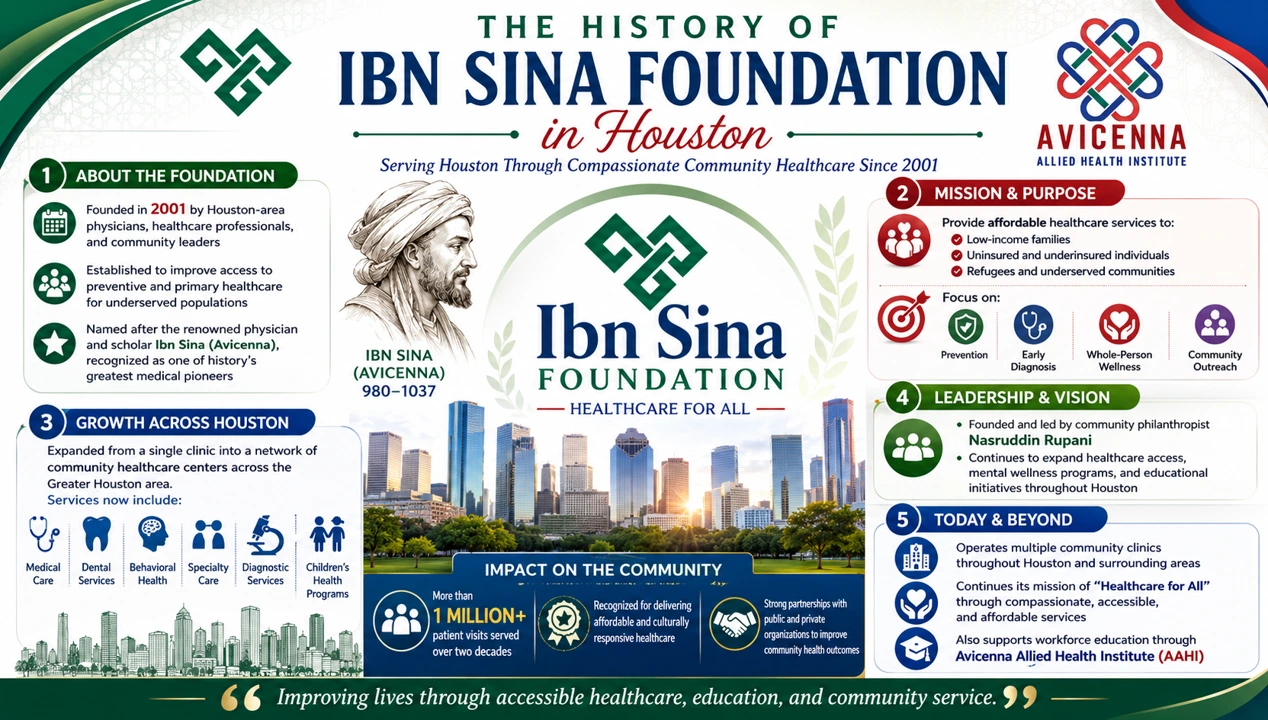
Since 2001, the Ibn Sina Foundation has worked to make affordable healthcare more accessible across Greater Houston. As its community clinic network grew, the Foundation saw another way to advance its Healthcare for All mission: prepare more people to deliver that care.
The Foundation established Avicenna Allied Health Institute (AAHI) to give people in the communities it serves a path into allied health careers. Through classroom instruction, skills labs, and supervised experience in community clinics for select programs, students learn how to care for patients and work as part of a healthcare team.
AAHI extends the Foundation’s community service through education. Students gain practical skills they can use to pursue healthcare careers, and local employers gain a source of trained candidates who understand the needs of the communities they serve.
Founded in 2001
Houston-area physicians, healthcare professionals, and community leaders established the Foundation to improve access to preventive and primary healthcare. Its name honors Ibn Sina (Avicenna), a physician and scholar who lived from 980 to 1037.
Who the Foundation serves
Its affordable care serves low-income families, uninsured and underinsured people, refugees, and other underserved communities. The Foundation emphasizes prevention, early diagnosis, whole-person wellness, and community outreach.
Growth across Greater Houston
A single clinic grew into a network offering medical, dental, behavioral health, specialty, diagnostic, and children’s services.
Leadership and community impact
Community philanthropist Nasruddin Rupani helped found and lead the Foundation. The Foundation’s history graphic reports more than one million patient visits over two decades and describes public and private partnerships that support community health.
Today and beyond
The Foundation continues its Healthcare for All mission through its clinics, mental wellness programs, and educational initiatives, including workforce training at AAHI.
Community and employer partners
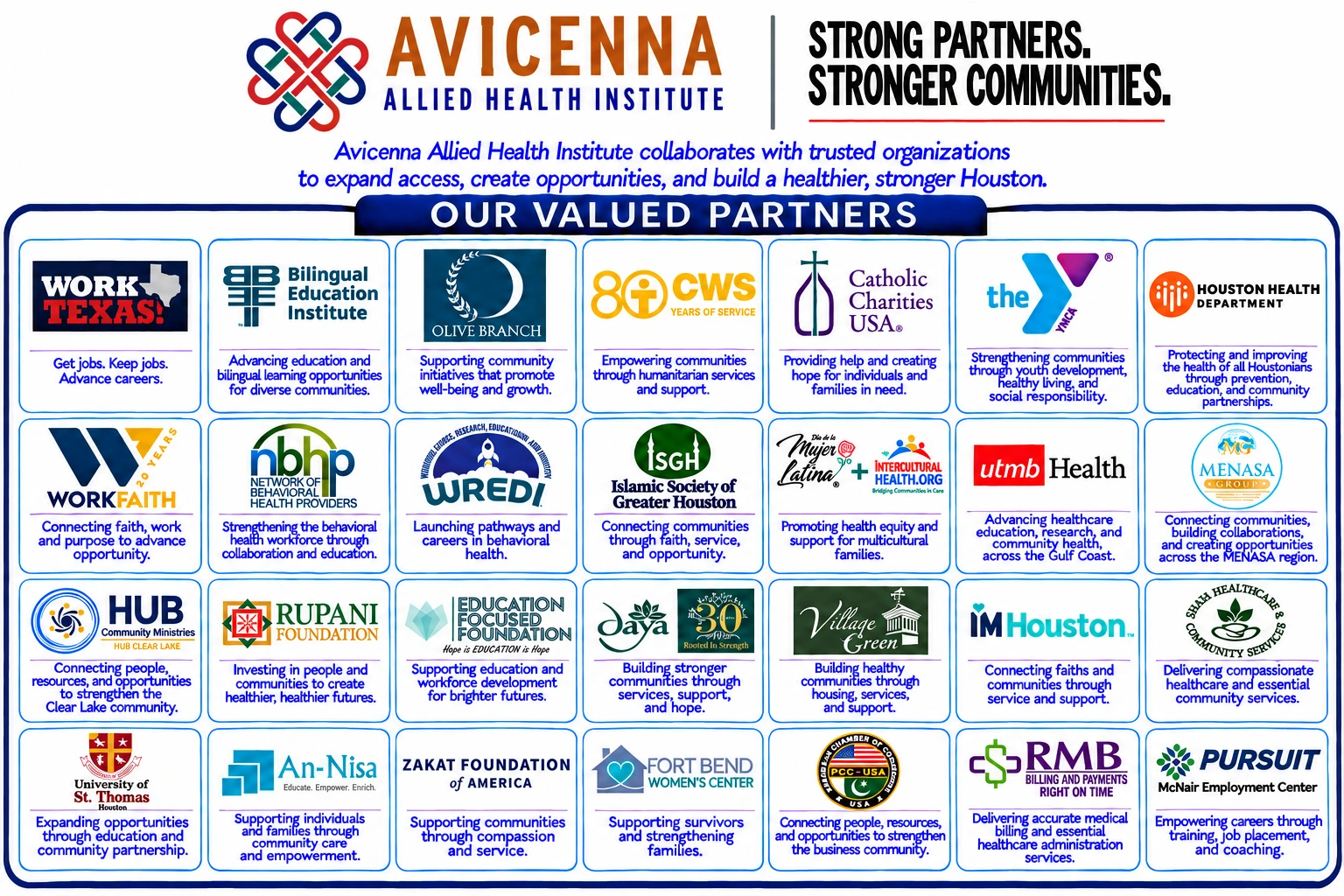
AAHI works with healthcare providers, employers, and community organizations to connect Houston-area students with training, support, and career opportunities.

View the original partner graphic
Read the partner directory
- WorkTexas
Job training, employment, and career advancement. - Bilingual Education Institute
Education and bilingual learning opportunities. - Olive Branch
Community initiatives that support well-being and growth. - Church World Service (CWS)
Humanitarian services and support. - Catholic Charities USA
Help for individuals and families in need. - YMCA
Youth development, healthy living, and social responsibility. - Houston Health Department
Public health prevention, education, and community partnerships. - WorkFaith
Career support connecting faith, work, and purpose. - Network of Behavioral Health Providers (NBHP)
Behavioral health workforce collaboration and education. - WREDI
Pathways to careers in behavioral health. - Islamic Society of Greater Houston (ISGH)
Community connections through faith, service, and opportunity. - Día de la Mujer Latina and Intercultural Health
Health equity and support for multicultural families. - UTMB Health
Healthcare education, research, and community health. - MENASA Group
Community connections, collaboration, and opportunity across the MENASA region. - The Hub Clear Lake
Resources and opportunities for the Clear Lake community. - Rupani Foundation
Investment in people and communities. - Education Focused Foundation
Education and workforce development. - Daya
Community services and support. - Village Green
Housing, services, and support. - IM Houston
Connections across faiths and communities through service. - Shifa Healthcare and Community Services
Healthcare and essential community services. - University of St. Thomas
Education and community partnerships. - An-Nisa
Community care and support for individuals and families. - Zakat Foundation of America
Community support and service. - Fort Bend Women’s Center
Survivor support and services for families. - Pakistan Chamber of Commerce USA
Connections and resources for the business community. - RMB Billing and Payments
Medical billing and healthcare administration services. - Pursuit McNair Employment Center
Training, job placement, and coaching.
Houston-area locations
Explore our campuses and clinics
Each Avicenna Allied Health Institute location serves as both a campus and a clinic. Our clinics provide hands-on learning in a healthcare setting. Ask Admissions which locations serve your program and where your classes, labs, or clinical sessions will take place. The guide lists experience such as patient intake, vital signs, phlebotomy, EKG, dental radiography, and infection control, depending on the site and program.
Wilcrest
11150 and 11226 S. Wilcrest Dr.
Houston, TX 77099
The guide also lists the Wilcrest Children’s Clinic at 11220 S. Wilcrest Dr.

Texas Workforce Commission Certificate of Approval
School number S61325
North Shepherd
5012 N. Shepherd Dr.
Houston, TX 77018
TWC school number S62561
South Post Oak
16345 S. Post Oak Rd.
Houston, TX 77053
TWC school number S63329
Clear Lake / Webster
15132 Old Galveston Rd.
Webster, TX 77598
TWC school number S63294
Opening soon
Before you apply
Admissions requirements
Applicants must be at least 18 and have a high school diploma or qualify under Ability to Benefit. Admissions can help you confirm which documents and assessments your program requires.
For a catalog in another format, email Admissions.
- Submit your application and photo ID. Provide the required enrollment documents and a valid government-issued photo ID.
- Meet with Admissions. Discuss your program choice, schedule, and readiness.
- Complete program-specific requirements. These can include health, safety, background, technology, or clinical documentation.
- Finish enrollment and attend orientation. Complete your enrollment agreement and any required financial arrangements.
Admissions
Request Information
Ask our admissions team about program options, campus availability, and how to get started.
Tuition and fees
Contact Admissions for tuition and fees for your program.
Next start date
January 11, 2027
Online application
Use Apply Now to open the Orbund application.